
How Does Something That Shouldn't Fly...Actually Fly? |
It weighs less than a paperclip, flies through strong winds, hovers with incredible precision and lands on flowers no bigger than a coin. Decades later, engineers are still trying to replicate what the humble bumblebee does every day. |
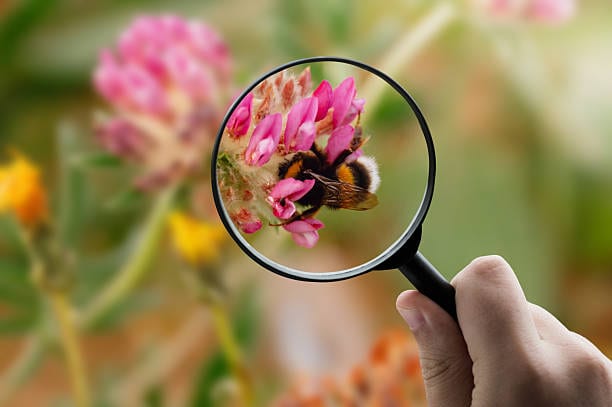
Watch a bumblebee for a minute.
Not in a documentary.
Not in slow motion.
Just in your garden.
It hovers effortlessly beside a flower, darts sideways in an instant, disappears into the wind and lands with remarkable precision on another bloom a few metres away. Most of us barely notice it. Engineers do.
Because building a machine that can fly with the same control, stability and efficiency is far more difficult than it looks.
Nature Solved the Problem Long Before We Did
For many years, people repeated the claim that bumblebees shouldn't be able to fly.
It became one of science's most enduring myths. The reality was much simpler.
Early calculations treated the bee as though it were a tiny aeroplane with fixed wings.
But bees don't fly like aeroplanes.
Using high-speed cameras and advanced computer modelling, scientists eventually discovered that bumblebees generate lift in a completely different way.
Their wings beat between 130 and 200 times every second, creating tiny swirling vortices that produce far more lift than earlier models predicted. Their wings also rotate rapidly at the end of each stroke, allowing them to generate lift throughout the entire wingbeat. These principles, known as unsteady aerodynamics, are now well established in insect flight research.
The bee wasn't breaking the laws of physics. It was following them in ways we hadn't yet understood.
Why Engineers Are Fascinated
Scientists aren't studying bumblebees because they want to build better insects.
They're studying them because they want to build better machines. Traditional drones rely on spinning propellers, which work well in open spaces but struggle in confined areas and turbulent air. Bumblebees do something very different.
When a gust of wind hits them, they don't simply flap harder. They make tiny adjustments to their wing motion and body position hundreds of times every second, allowing them to stay remarkably stable even in challenging conditions. Researchers continue to study these control strategies because they could improve the next generation of flapping-wing robots and autonomous flying systems.
Tiny Wings, Big Ideas
The technology inspired by insects is already influencing research around the world.
Scientists are developing miniature flying robots that could one day:
The Real SurprisePerhaps the most remarkable part of the story isn't that humans are copying bees.
It's that nature found an elegant solution millions of years before we had the tools to understand it.
Every bumblebee you see hovering over a flower is performing thousands of tiny aerodynamic adjustments every minute, without computers, sensors or software.
Meanwhile, some of the world's brightest engineers are still working out how to build a machine that can do the same.
The Bottom Line
The next time a bumblebee pauses beside a flower, take a second look.
You're not just watching an insect collecting nectar.
You're watching one of nature's most sophisticated flying machines.
And while technology continues to advance at an astonishing pace, one tiny creature still reminds us that some of the best engineering ideas were perfected long before humans ever drew their first blueprint. |
More from Joburg Insider

Sep 28, 2026
A useful conversation for parents of young readers
New classroom resources are being procured for the next school year. Here’s what to ask your child’s school and how to help at home.

Sep 28, 2026
Your first taste of Nigerian food in Joburg
From jollof rice in Gallo Manor to West African dishes in Sunninghill, local menus offer an introduction to a rich food culture.

Sep 28, 2026
From Emperors Palace to a world title in Tokyo
After fighting his first 19 professional bouts at Emperors Palace, the “Magic Man” travelled to Japan and claimed the WBC super flyweight crown.

Sep 25, 2026
When an AI Security Test Reached Real Companies
A Google Gemini test accidentally reached three real businesses, showing why AI tools need carefully controlled access.
0 Comments
Join the conversation
Be the first to comment
Share your thoughts above.