
How giraffes handle the pressure of being so tall |
Even a drink of water demands careful blood-pressure control, and South African research is helping explain how their bodies cope. |
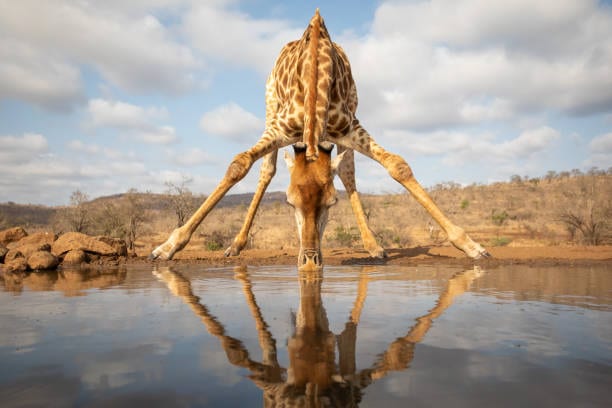
A giraffe lowers its head to drink, then lifts it metres into the air. Inside its body, that everyday movement creates a challenge: keeping blood flowing to the brain as gravity changes its effect.
The tallest land animal needs unusually high blood pressure to push blood up its neck. It also needs ways to protect delicate blood vessels when its head drops towards the ground.
An uphill job for the heart
With its head upright, a giraffe’s brain can sit more than two metres above its heart.
Adult giraffes have an average arterial pressure at heart level of around 200–250 mmHg, more than twice that of most mammals. This is pressure averaged across the heartbeat, rather than the familiar two-number reading used in a blood-pressure check.
The heart’s main pumping chamber, the left ventricle, has a thick muscular wall suited to this demanding job.
Why spread their legs to drink?
Even that long neck cannot comfortably reach ground-level water while a giraffe stands normally. Spreading or bending its front legs lowers its body enough for its mouth to reach.
As its head moves below its heart, gravity increases pressure toward the head. Its circulation must adjust.
Researchers studying drinking giraffes in 2025 found that:
Tests also showed that small arteries supplying the brain narrowed strongly in response to increased pressure, helping protect delicate vessels downstream.
Long legs help the heart, too.
The neck gets most of the attention, but the legs also matter.
A 2025 modelling study co-authored by the University of Pretoria’s Edward Snelling and the University of Adelaide’s Roger Seymour explored how the heart’s position affects its workload.
Long legs lift the heart higher. Compared with an animal of the same overall height but shorter legs and a longer neck, this reduces the uphill distance to the brain and the energy needed to pump blood there.
Could this help human health research?
In a 2021 study, mice engineered to carry giraffe-specific changes in a gene called FGFRL1 showed resistance to experimentally induced high blood pressure.
The finding offers a clue for research into human hypertension, although it does not establish a treatment for people.
This work addresses a familiar human concern. High blood pressure often causes no symptoms but can damage the heart, brain and kidneys. The South African Medical Research Council encourages regular blood-pressure checks to help detect it early.
One more surprising fact: natural compression stockings
Giraffes also have protection near their feet. Their tight leg skin provides support rather like compression stockings, helping prevent blood and tissue fluid from pooling in the lower limbs.
Small blood vessels also narrow before blood reaches the capillaries, helping limit swelling. Researchers described the skin’s supporting role as a natural anti-gravity suit.
The Bottom Line
The next time a giraffe bends for a drink, watch the whole animal. Its height depends on adaptations extending from its heart and brain right down to the skin around its legs. |
More from Joburg Insider

Sep 21, 2026
A chance paddle became a bigger ambition
The Gauteng kayaker has represented South Africa overseas and is developing her coaching skills alongside her own sporting ambitions.

Sep 21, 2026
Homemade carts take over Sandton Drive
The wild unpowered go kart race returns to Sandton Drive on 20 September 2026. Teams can still apply to compete.

Sep 20, 2026
A Hands-on Day of Discovery
Nearly 400 interactive exhibits make this Newtown attraction an easy choice for a curious family day out.

Sep 19, 2026
A Family Meal with Space to Play
Golf-course views, good food and a large outdoor play area in Linksfield North.
0 Comments
Join the conversation
Be the first to comment
Share your thoughts above.